English
 日本語
日本語
The right concrete block anchors depend on the load type, block material density, and whether the anchor will be used in the face shell, web, or hollow core of the block — and choosing the wrong type can result in pull-out failures at a fraction of the rated load. Concrete block anchors (also called CMU anchors, masonry anchors, or hollow-block fasteners) are mechanical or adhesive fastening systems specifically engineered to secure structural and non-structural connections to concrete masonry unit (CMU) walls, retaining block, and decorative block. This guide covers every major anchor type, their load ratings, installation requirements, and the critical differences between them so you can select and install the correct fastener the first time.
Content
- What Makes Concrete Block Anchors Different from Solid Concrete Anchors?
- How Many Types of Concrete Block Anchors Are There?
- Which Concrete Block Anchor Type Performs Best for Each Application?
- How to Install Concrete Block Anchors Correctly
- What Material Should Concrete Block Anchors Be Made From?
- How to Calculate the Number of Concrete Block Anchors Needed
- Frequently Asked Questions About Concrete Block Anchors
- Conclusion: Choosing and Installing the Right Concrete Block Anchors
What Makes Concrete Block Anchors Different from Solid Concrete Anchors?
Concrete block anchors must be engineered differently from solid concrete fasteners because CMU blocks are hollow — typically 50 to 75 percent void space — meaning a standard expansion anchor that works by wedging against the surrounding material will either crack the thin face shell or pull through the void entirely. Standard concrete expansion anchors depend on lateral pressure against a continuous material mass; CMU walls do not provide that mass at the anchor location unless the anchor is specifically designed to span across or bear against the block geometry.
The three structural challenges unique to block anchoring are:
- Thin face shells: Standard CMU face shells are only 1.25 to 1.5 inches (32 to 38 mm) thick — insufficient bearing area for high expansion forces
- Hollow cores: The void behind the face shell provides no material for mechanical anchors to bear against unless the anchor design specifically accounts for it
- Variable block strength: CMU compressive strength ranges from 1,000 psi in lightweight decorative block to over 3,000 psi in dense structural block, requiring anchor selection matched to the specific block type
- Mortar joint interference: Anchors placed in or near mortar joints engage weaker material than the block face, significantly reducing pull-out resistance
How Many Types of Concrete Block Anchors Are There?
There are six primary categories of concrete block anchors, each using a different mechanism to develop holding strength within or through the CMU structure. Understanding each type's working principle is essential to matching the anchor to the application.
1. Sleeve Anchors
Sleeve anchors are among the most versatile concrete block anchors for medium-load applications. A sleeve anchor consists of a threaded bolt surrounded by a segmented metal sleeve. When the nut is tightened, the bolt pulls a cone-shaped expander upward into the sleeve, forcing the sleeve segments outward against the surrounding material. In CMU block, sleeve anchors must be installed in the face shell only — the expansion must occur within the shell thickness, not in the void. Sleeve anchors are available in diameters from 1/4 inch to 3/4 inch and lengths from 2 inches to 8 inches. In standard-weight CMU, a 3/8-inch sleeve anchor achieves a tensile pull-out of approximately 1,300 to 1,900 lbs depending on embedment depth and block strength.
2. Toggle Bolt Anchors (Hollow-Wall Anchors)
Toggle bolt anchors are the most appropriate concrete block anchors when the void in the block core must be used for load transfer. A toggle bolt passes through a drilled hole in the face shell, and the spring-loaded or gravity-toggle wings open behind the shell wall in the hollow core. When the bolt is tightened, the wings bear against the inside face of the shell — distributing the load across a larger area than the drill hole alone. Toggle bolts in block are rated for 50 to 200 lbs shear per anchor depending on shell thickness and toggle wing size. They are suitable for non-structural applications: shelf brackets, light fixtures, conduit straps, and similar.
3. Screw Anchors (Masonry Screws / Tapcon-Style)
Masonry screw anchors — sometimes generically called Tapcon-style anchors — are hardened steel screws with a specialized hi-lo thread pattern that cuts directly into pre-drilled holes in concrete or block without requiring a separate anchor body. In CMU block applications, masonry screws work best when driven into the solid web or cross-brace material rather than the face shell, as the thread engagement requires a minimum material depth. Standard 3/16-inch masonry screws achieve approximately 200 to 500 lbs shear and 100 to 350 lbs tension in normal-weight CMU, depending on embedment depth (minimum 1 inch, optimal 1.5 to 1.75 inches). These are among the fastest-installing concrete block anchors — no separate anchor body required, removable and reusable in the same hole up to approximately 5 times before thread engagement degrades.
4. Adhesive / Epoxy Anchors
Adhesive anchors for concrete block use two-component epoxy or hybrid polyester resins injected into a drilled hole via a static-mixing nozzle before a threaded rod or rebar is inserted. Epoxy anchors in CMU block require screen tubes — wire mesh cylinders inserted into the hole before the adhesive — because the hollow void would otherwise allow the fluid epoxy to flow into the core rather than bonding to the hole walls. The screen tube confines the adhesive within the face shell depth. Epoxy-anchored threaded rod (1/2-inch diameter) in normal-weight CMU with screen tube achieves tensile values of 2,500 to 5,000 lbs after full cure — the highest load ratings available for individual concrete block anchors. Cure time varies from 20 minutes at 70°F to 4 hours at 40°F and must be fully elapsed before loading.
5. Hammer-Set Anchors (Drive Anchors)
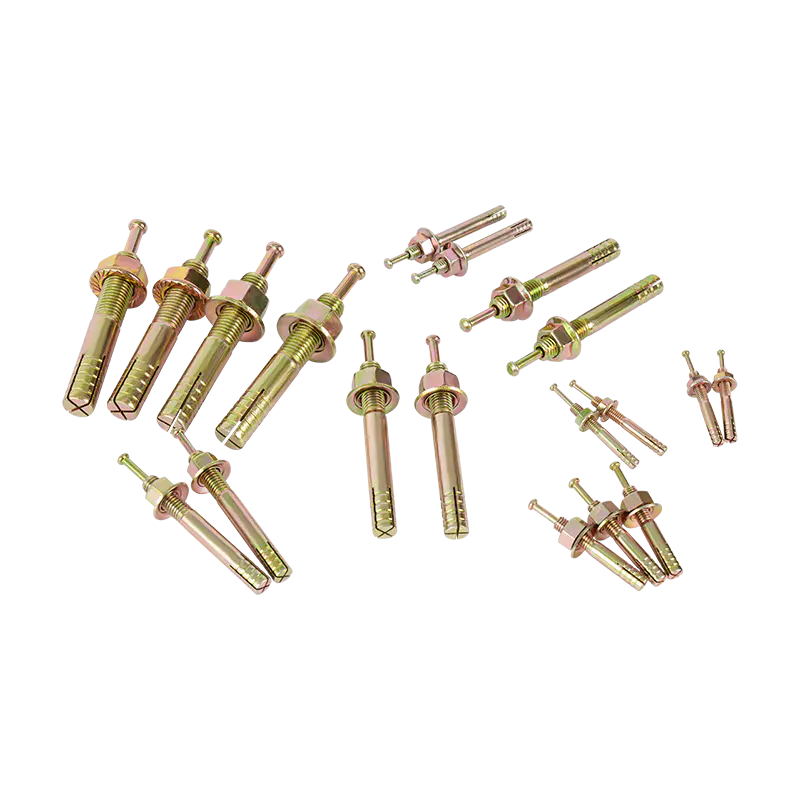
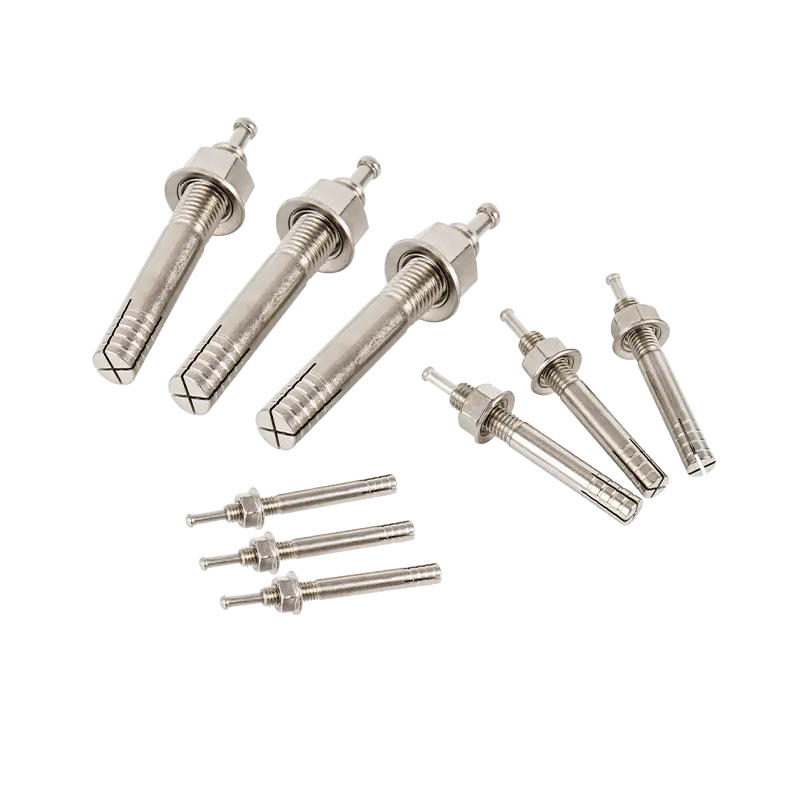
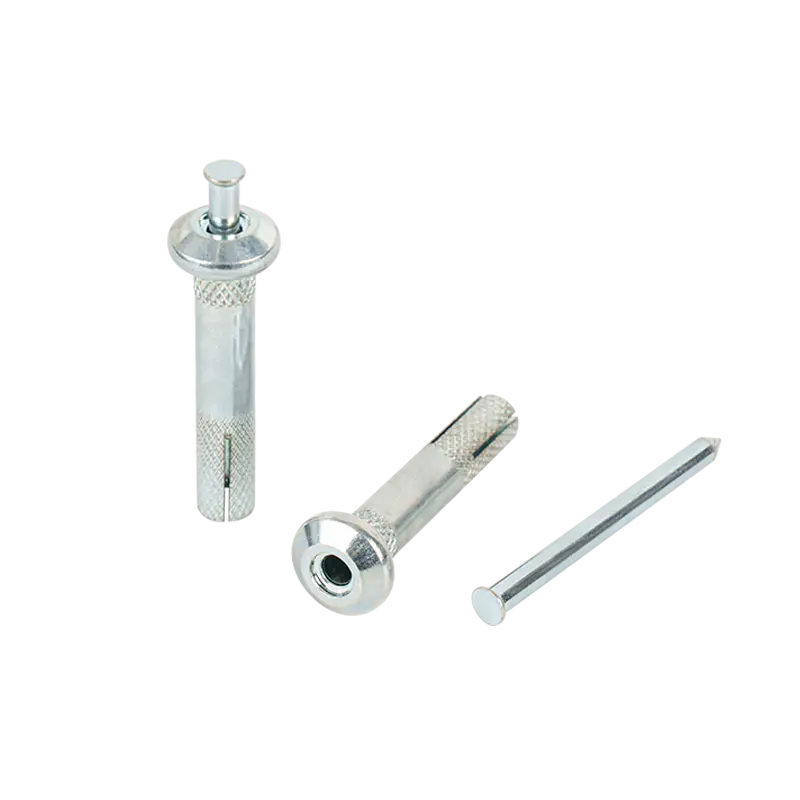
Hammer-set anchors (also called drive anchors or nail-in anchors) are the fastest-installing option for light-duty concrete block anchoring. A pre-assembled nail is driven through a metal sleeve inserted into a pre-drilled hole; the nail expands the sleeve against the hole wall. In CMU applications, hammer-set anchors must be used only in the solid sections of the block (face shell or web) and are limited to light shear loads — typically 100 to 400 lbs in shear and 50 to 200 lbs in tension depending on size (available in 1/4-inch and 3/8-inch diameters). They are not removable once set and are best suited for permanent, non-critical attachments such as conduit anchors, furring strips, and similar applications.
6. Through-Bolt Anchors
Through-bolt anchors pass a threaded rod or bolt completely through the full thickness of the CMU wall, with a bearing plate or nut on each face. This method bypasses the hollow-core limitation entirely by bearing against the full wall assembly rather than relying on anchor engagement within a single face shell. Through-bolts achieve the highest load ratings of any concrete block anchor method — a 1/2-inch threaded rod through a standard 8-inch CMU wall with 3-inch square bearing plates can develop tensile loads exceeding 10,000 lbs before block or rod failure. The limitation is access — both faces of the wall must be reachable, which is not possible in finished walls or walls against grade.
Which Concrete Block Anchor Type Performs Best for Each Application?
Selecting the optimal concrete block anchor requires matching the anchor's load capacity and installation method to the specific application requirements. The table below compares all six types across the criteria that matter most in the field.
| Anchor Type | Typical Tensile Load | Typical Shear Load | Install Speed | Removable | Best Application |
| Sleeve Anchor | 1,300 – 1,900 lbs | 1,000 – 2,500 lbs | Fast | Yes | Structural brackets, handrails, equipment |
| Toggle Bolt | 50 – 200 lbs | 75 – 250 lbs | Moderate | Bolt only | Light fixtures, shelf brackets, conduit |
| Masonry Screw | 100 – 350 lbs | 200 – 500 lbs | Very fast | Yes (limited) | Furring strips, door frames, straps |
| Epoxy / Adhesive | 2,500 – 5,000 lbs | 3,000 – 6,000 lbs | Slow (cure time) | No | Rebar dowels, heavy structural connections |
| Hammer-Set | 50 – 200 lbs | 100 – 400 lbs | Fastest | No | Conduit, furring strips, permanent trim |
| Through-Bolt | 5,000 – 10,000+ lbs | 5,000 – 12,000+ lbs | Slow | Yes | Ledger boards, structural beam connections |
Table 1: Performance and application comparison of six concrete block anchor types by load capacity, installation speed, removability, and best use case.
How to Install Concrete Block Anchors Correctly
Correct installation of concrete block anchors is as important as selecting the right type — an incorrectly installed anchor of any type will perform below rated capacity, sometimes dramatically so. The following steps apply to all mechanical anchor types; adhesive anchors have additional requirements detailed separately.
General Installation Steps for Mechanical Concrete Block Anchors
- Locate the solid material: Before drilling, use a stud finder set to AC or masonry mode, or tap the wall surface to identify the location of the block web and face shell solid sections. Mark drill locations within the solid material, not in the hollow core or at mortar joints. Mortar joint strength is only 40 to 60 percent of block strength — anchoring in mortar joints reduces capacity proportionally.
- Select the correct drill bit: Use a carbide-tipped masonry bit sized to the anchor manufacturer's specification. For most concrete block anchors, the bit diameter matches the anchor body diameter for mechanical types, or is 1/16 inch larger than the threaded rod for adhesive anchors. Standard drill bits will not cut masonry and will overheat and fail.
- Use hammer drill mode: Set your drill to hammer-drill mode for all CMU drilling. A rotary-only drill will work but is significantly slower and generates more heat, which can cause bit dulling and hole oversize from heat expansion. A 1/2-inch hole in standard CMU should take approximately 15 to 30 seconds in hammer mode.
- Drill to the correct depth: Drill at least 1/2 inch deeper than the required anchor embedment depth to allow for drill dust accumulation at the hole bottom. Insufficient depth prevents the anchor from reaching full embedment, reducing load capacity.
- Clean the hole thoroughly: Blow out all dust and debris using compressed air (minimum two passes) and brush the hole with a wire brush (minimum two passes). Drill dust left in the hole is the single most common cause of below-rated anchor performance in both mechanical and adhesive systems. For adhesive anchors, the hole must be completely dry as well.
- Install and torque to specification: Insert the anchor and apply the manufacturer's recommended installation torque. Under-torquing leaves the expansion incomplete; over-torquing can crack the face shell. Most 3/8-inch sleeve anchors in CMU specify 25 to 35 ft-lbs installation torque.
Additional Steps for Epoxy Anchor Installation in CMU Block
- Insert the screen tube: Push the wire mesh screen tube into the cleaned hole so it bottoms out. The screen tube must match the hole diameter and be long enough to extend from the bottom to within 1/4 inch of the hole opening.
- Dispense and discard the first 2 inches of mixed adhesive: The first material dispensed through a new mixing nozzle is incompletely mixed. Always discharge the first 2 inches onto cardboard before injecting into the hole. Using partially mixed adhesive results in significantly reduced bond strength.
- Fill from the bottom up: Insert the nozzle to the bottom of the screen tube and withdraw it slowly as you dispense. Fill the hole to approximately 2/3 full — the threaded rod displaces volume when inserted and excess adhesive will overflow the hole at correct fill levels.
- Insert and twist the threaded rod: Push the threaded rod through the screen tube with a slow rotation to ensure complete adhesive contact on all thread surfaces. Do not disturb the rod until the manufacturer's cure time has fully elapsed.
- Observe full cure before loading: Epoxy anchor systems have temperature-dependent cure times. At 70°F, most systems cure in 45 to 90 minutes. At 40°F, cure time extends to 4 to 6 hours. Loading an epoxy anchor before full cure is complete can result in pull-out values as low as 20 to 30 percent of the rated capacity.
What Material Should Concrete Block Anchors Be Made From?
The material specification of a concrete block anchor determines its long-term corrosion resistance and load-bearing durability — particularly in exterior, wet, or chemically aggressive environments where a corroding anchor can fail years before its mechanical rating would suggest.
| Material | Corrosion Resistance | Strength | Suitable Environments | Relative Cost |
| Zinc-plated carbon steel | Low — suitable for dry interior only | High | Dry interior walls only | Lowest |
| Hot-dip galvanized steel | Moderate — suitable for general exterior | High | Exterior, covered, non-marine | Low-moderate |
| 304 Stainless steel | Good — resists most atmospheric corrosion | High | Exterior, light industrial, mild marine | Moderate |
| 316 Stainless steel | Excellent — resists chloride environments | High | Marine, coastal, chemical exposure | High |
| Nylon / plastic body | Excellent — immune to corrosion | Low — light duty only | Wet interior, light exterior, chemical | Very low |
Table 2: Material selection guide for concrete block anchors by corrosion resistance, strength, suitable environment, and relative cost.
For exterior concrete block anchor applications — retaining walls, fence post anchors, exterior ledger connections — hot-dip galvanized or 304 stainless steel is the minimum specification. In coastal environments within 1,000 feet of saltwater, 316 stainless steel is required. The CMU block itself is alkaline (pH 12 to 13), which accelerates corrosion of unprotected carbon steel anchors even in interior locations if any moisture is present.
How to Calculate the Number of Concrete Block Anchors Needed
Correct anchor quantity calculation for a concrete block anchor installation requires applying a safety factor to the working load — published anchor load ratings are ultimate failure values, not safe working loads. Never design an installation to the published ultimate load value.
Safety Factor Requirements by Application Type
| Application Type | Minimum Safety Factor | Working Load = Ultimate / Factor | Example |
| Static non-structural (shelving, conduit) | 4:1 | 25% of ultimate rating | 1,600 lb ultimate = 400 lb working load |
| Structural (handrails, brackets, frames) | 5:1 | 20% of ultimate rating | 1,600 lb ultimate = 320 lb working load |
| Life-safety (overhead, seismic, fall arrest) | 10:1 | 10% of ultimate rating | 1,600 lb ultimate = 160 lb working load |
| Seismic design (IBC/ASCE 7 regions) | Per ICC-ES ESR report values | Use ACI 318 Appendix D design method | Requires licensed engineer review |
Table 3: Safety factor requirements for concrete block anchor load calculations by application category, with working load derivation examples.
Practical example: A wall-mounted storage rack imposes a 600-pound total load on four concrete block anchors in shear. With a 4:1 safety factor, each anchor requires a working shear capacity of at least 600 ÷ 4 ÷ 4 = 37.5 lbs per anchor against the working load (or the anchor must have an ultimate shear rating of at least 150 lbs each). A standard 3/16-inch masonry screw rated at 200 to 300 lbs ultimate shear would comfortably meet this requirement with margin. For a structural handrail with a 250-lb design point load and a 5:1 safety factor, each anchor needs 1,250 lbs ultimate shear — requiring at minimum a 3/8-inch sleeve anchor or epoxy anchor.
Frequently Asked Questions About Concrete Block Anchors
Can standard concrete expansion anchors be used in concrete block?
Standard wedge-style concrete expansion anchors designed for solid concrete should not be used in CMU block without verifying that the embedment zone is entirely within solid material — the face shell or web. If the expansion zone falls in the hollow core, the anchor will not develop rated load values and may fail at 10 to 20 percent of the rated capacity. For most CMU applications, sleeve anchors, masonry screws, or epoxy systems are more appropriate choices than standard wedge anchors.
How close to the edge of a block can concrete block anchors be installed?
Minimum edge distance for concrete block anchors is typically 1.5 to 2 times the anchor diameter from the nearest block edge, and a minimum of 3 to 4 anchor diameters from an adjacent anchor (center to center spacing). Installing closer to a block edge risks splitting the face shell under expansion forces. For epoxy anchors, the minimum edge distance is typically 3 times the anchor diameter. Always consult the anchor manufacturer's technical data sheet for the specific minimum edge and spacing requirements for the anchor and block type being used.
Do concrete block anchors work in lightweight or aerated block?
Lightweight CMU (density below 105 pcf) and aerated autoclaved concrete (AAC block) have significantly lower compressive and tensile strength than normal-weight CMU. Published anchor load values for normal-weight CMU do not apply to lightweight or AAC block — actual pull-out values may be 40 to 60 percent lower. For AAC block specifically, only anchors that have been tested and carry ICC-ES evaluation service reports for AAC should be used, as standard concrete block anchor designs may pull out at loads far below safe working limits in this substrate.
What drill bit size is needed for concrete block anchor installation?
The correct drill bit size matches the anchor body diameter exactly for mechanical expansion anchors — a 3/8-inch sleeve anchor requires a 3/8-inch carbide masonry bit. For masonry screws, the bit is typically 1/16 inch smaller than the screw's major thread diameter — a 3/16-inch masonry screw uses a 5/32-inch bit. For epoxy anchor systems with threaded rod, the bit is 1/16 inch larger than the rod — 1/2-inch threaded rod uses a 9/16-inch bit. Using an incorrect bit diameter is one of the most common installation errors and directly compromises anchor performance in either direction: oversized holes reduce expansion effectiveness; undersized holes prevent full embedment.
Can concrete block anchors be removed and reused?
Sleeve anchors and through-bolt systems are removable — the nut is removed and the bolt withdrawn, leaving the sleeve in the hole. The sleeve itself cannot be reused in the same hole but the bolt and nut can be reused in a new installation. Masonry screws can be removed and the same screw reinstalled in the same hole approximately 3 to 5 times before thread engagement degrades to the point where load ratings are no longer reliable. Hammer-set anchors and epoxy adhesive anchors are permanently installed and cannot be removed without destroying the anchor and damaging the surrounding block material. If temporary fastening is required, sleeve anchors or masonry screws are the correct choice.
Are concrete block anchors suitable for overhead (tension) loading?
All concrete block anchors can be loaded in tension (overhead or pullout direction), but overhead loading in a life-safety application requires engineering review. Overhead loading introduces dynamic and impact load considerations that static ratings do not account for. For overhead structural applications — suspended ceilings, overhead equipment, fall arrest anchor points — only anchors with specific ICC-ES evaluation reports for seismic or overhead use should be specified, and installation must be performed by a qualified contractor. The safety factor for overhead life-safety anchors is 10:1 minimum, which limits even a high-rated 3/8-inch sleeve anchor (1,600 lb ultimate tension) to a 160-lb working load overhead.
Conclusion: Choosing and Installing the Right Concrete Block Anchors
The full range of concrete block anchors — from a $0.30 hammer-set drive anchor for a conduit strap to a fully engineered epoxy anchor system for a structural ledger connection — all share the same fundamental requirement: the anchor must be matched to the block type, the void geometry, the applied load, and the environmental conditions. No single anchor type performs optimally across all applications, and the difference between the correct and incorrect choice is not a matter of incremental performance reduction — it is the difference between a system that works safely for decades and one that fails catastrophically at a fraction of its intended load.
For light-duty interior installations, masonry screws offer the best combination of speed, adjustability, and adequate load capacity. For medium-duty structural applications in accessible face shell material, sleeve anchors provide reliable performance with easy installation. For the highest-load structural connections or where the hollow core must be engaged, epoxy anchors with screen tubes are the engineering-grade solution. And when both faces of the wall are accessible and maximum load is required, through-bolt anchoring with bearing plates eliminates the limitations of face-shell-only anchoring entirely.
Always apply appropriate safety factors, specify the correct material grade for the environment, clean drill holes thoroughly before installation, and consult a licensed structural engineer for any life-safety or seismic-design application of concrete block anchors. The investment in correct specification pays dividends in reliable, long-term performance for every connection the anchor serves.